
Compare three mortgage strategies for the same home. Learn how down payments, seller concessions, and loan structure can affect your buying power.
One Home. Three Financing Strategies. Which Wins?
The same home. The same purchase price. Three different ways to finance it. Which strategy makes the most financial sense?
When buying a home, most people focus on two numbers: the purchase price and the mortgage rate.
Both matter. But neither tells the whole story.
What if two buyers purchase the same $1.5 million property, yet their financing decisions produce significantly different monthly payments, upfront cash requirements, and long-term costs?
That's entirely possible.
The difference may come down to how the mortgage is structured, which lending options are considered, and how the purchase is negotiated.
In a market where borrowing costs remain a major consideration, understanding these differences can be particularly valuable.
Let's examine three potential strategies for purchasing the same home—and why choosing the right approach requires more than simply comparing advertised mortgage rates.
The Scenario: A $1.5 Million Home
Imagine you've found a property you love in Miami, San Francisco, or another competitive real estate market.
Here are the basic assumptions:
- Purchase price: $1,500,000
- Mortgage term: 30 years
- Illustrative fixed interest rate: 7.00%
- Property taxes, insurance, HOA dues, and closing costs: Excluded from the payment illustrations unless otherwise stated
The 7.00% interest rate is hypothetical and used solely to demonstrate the differences between financing structures. It is not a current rate quote or an offer of financing.
We'll explore three strategies:
- Traditional financing with 20% down.
- Seller concessions used to fund a temporary 2-1 mortgage buydown.
- A larger down payment designed to reduce monthly obligations.
Each approach has potential advantages and trade-offs.
And importantly, the strategy with the lowest initial monthly payment isn't necessarily the best overall financial decision.
Strategy 1: Traditional Financing With 20% Down
This is a familiar approach for many qualified homebuyers.
The buyer contributes 20% of the purchase price and finances the remaining 80%.
The Numbers
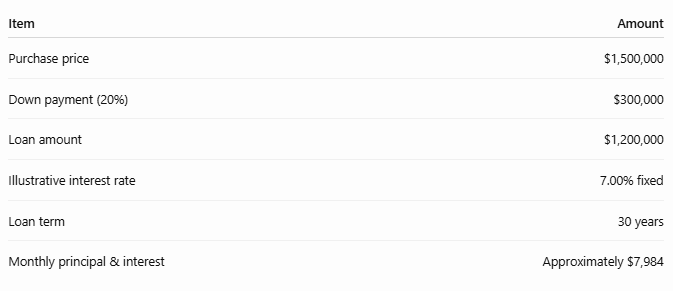
Monthly payment excludes property taxes, homeowners insurance, HOA dues, and other applicable expenses.
Why This Strategy May Work
A 20% down payment can offer several benefits, depending on the loan program and borrower qualifications.
It may help avoid private mortgage insurance, preserve more liquidity than a larger down payment, and provide a straightforward long-term payment structure.
For a buyer with stable income, sufficient reserves, and a desire to retain investment capital, this approach may make sense.
The Trade-Off
The buyer assumes the full principal-and-interest payment from the beginning.
In addition, the $300,000 down payment is only part of the cash required to close. Taxes, insurance, lender fees, title expenses, prepaid items, and other transaction costs must also be considered.
The question: Is preserving more liquidity worth the higher monthly mortgage payment?
That depends on the buyer's broader financial position and objectives.
Strategy 2: Negotiate Seller Concessions for a Temporary 2-1 Buydown
Now consider the same home, at the same purchase price, with the same $1.2 million mortgage.
But this time, the buyer negotiates an eligible seller concession that helps fund a temporary mortgage payment buydown.
A 2-1 buydown temporarily subsidizes the borrower's monthly principal-and-interest payment during the first two years.
The contractual note rate remains unchanged.
Using the same hypothetical 7.00% fixed note rate, the payments would be calculated as though the rate were:
- Year 1: 5.00%
- Year 2: 6.00%
- Years 3–30: 7.00%
The Numbers
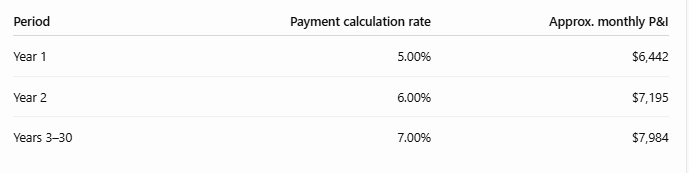
These are illustrative subsidized payments, not changes to the contractual note rate. The borrower must meet the applicable qualification requirements based on the loan program.
What Does This Mean?
Compared with the full payment, the borrower could receive an approximate payment subsidy of:
Year 1: $1,542 per month.
Year 2: $789 per month.
That represents approximately $27,972 in total temporary payment assistance over the first 24 months, subject to final loan calculations and the terms of the buydown agreement.
The required buydown funds are typically deposited into a designated account at closing and applied toward the scheduled payment subsidy.
Seller contributions must comply with the applicable loan program's concession limits and other eligibility requirements.
Why This Strategy May Work
A temporary buydown can help reduce initial monthly cash outflow.
This may be useful for buyers who anticipate near-term expenses related to moving, furnishing a property, or managing a financial transition.
It can also create a different negotiating opportunity.
Instead of focusing exclusively on reducing the purchase price, the buyer and seller can evaluate whether an eligible closing-cost concession provides more immediate value.
The Trade-Off
The payment subsidy is temporary.
Beginning in Year 3, the borrower is responsible for the full payment associated with the original note rate.
A buyer should not assume mortgage rates will decline or that refinancing will be available before the buydown period expires.
The question: Is short-term payment flexibility more valuable than a permanent reduction in principal or interest costs?
The answer depends on the borrower's cash flow, liquidity, financial stability, and long-term plans.
Strategy 3: Increase the Down Payment to Reduce the Monthly Obligation
Let's consider a third approach.
Instead of putting 20% down, the buyer contributes 30%.
The purchase price remains $1.5 million, but the loan amount decreases.
The Numbers
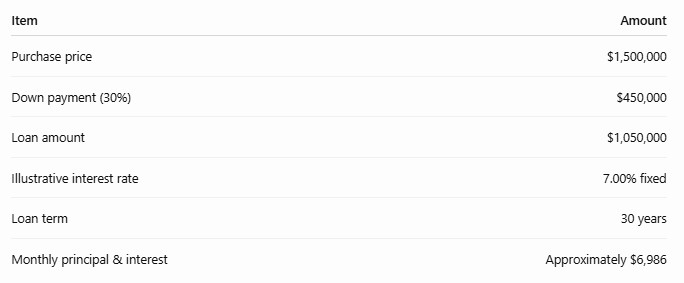
Payment excludes taxes, insurance, HOA dues, and other applicable expenses.
Why This Strategy May Work
The buyer reduces the principal balance by $150,000 compared with the 20%-down scenario.
At the same hypothetical interest rate and term, that lowers monthly principal and interest by approximately $998.
It also reduces total interest expense over the life of the loan if the mortgage is held to maturity and payments are made as scheduled.
The Trade-Off
The buyer commits an additional $150,000 of liquid capital to the property.
That capital may otherwise have been available for investments, business opportunities, emergencies, or other financial needs.
For a high-net-worth borrower, retaining liquidity may be more valuable than minimizing the mortgage payment.
For another buyer, reducing monthly obligations may be the higher priority.
The question: Is it better to put more money into the home—or keep that capital available elsewhere?
There isn't one universal answer.
Side-by-Side: Which Financing Strategy Wins?
Let's compare the three approaches using the same hypothetical property and interest rate.
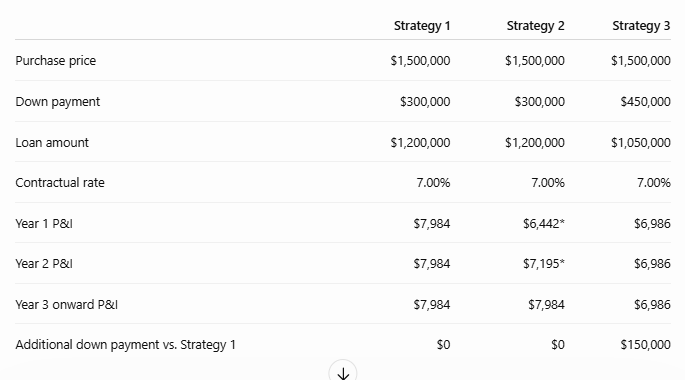
Strategy 2 payments reflect a temporary subsidy funded upfront. All figures are approximate and illustrative.
So, which strategy wins?
It depends on what you're trying to accomplish.
If preserving liquidity is the priority, Strategy 1 may deserve consideration.
If reducing payments during the first two years is important, Strategy 2 may offer a useful temporary benefit when eligible seller concessions are available.
If minimizing the ongoing monthly mortgage payment is the goal, Strategy 3 may be attractive, provided the buyer is comfortable committing more capital.
But the comparison doesn't end there.
A complete evaluation should also consider total interest expense, the cost and source of any buydown funds, closing costs, lender fees, APR, opportunity cost of capital, anticipated holding period, and whether the borrower expects to sell or refinance.
The lowest payment today may not produce the lowest total cost tomorrow.
And the loan with the lowest total interest expense may not be the best use of a borrower's available capital.
That's why financing should be approached as a strategy—not simply a rate quote.
What About Different Lenders and Loan Programs?
The examples above hold the interest rate constant to isolate the effects of loan structure.
In practice, however, different lenders may offer different pricing, qualification guidelines, loan programs, fees, and reserve requirements.
That's another important consideration.
A traditional bank may have one set of requirements.
A credit union may offer another.
A portfolio lender may evaluate certain borrower or property characteristics differently.
And a specialty lender may provide an option for a qualified borrower who doesn't fit conventional documentation guidelines.
These differences can become especially relevant for:
- Self-employed borrowers and business owners.
- High-net-worth individuals with substantial assets.
- Jumbo and super-jumbo mortgage borrowers.
- Real estate investors.
- Foreign nationals.
- Buyers purchasing complex condominium projects or unique properties.
- Borrowers seeking bridge financing or other specialized structures.
Not every loan program will be available to every borrower or property. Alternative lending programs may also carry higher costs, different documentation requirements, or additional risks.
The objective is to identify the options that genuinely fit the transaction—not simply to maximize the number of lenders contacted.
Why the Right Mortgage Advisor Matters
Mortgage financing is about more than obtaining an approval.
A strong advisor should help borrowers understand how their financing decisions affect the larger transaction.
That includes evaluating:
Monthly affordability: What payment is sustainable given the borrower's broader financial obligations?
Liquidity: How much capital should be invested in the property, and how much should remain available?
Financing flexibility: Which loan programs and structures fit the borrower's financial profile?
Negotiation opportunities: Could seller concessions or other contract terms improve the transaction?
Long-term objectives: How long does the buyer expect to own the property, and how might their financial circumstances change?
Risk: What happens if rates remain elevated, income changes, or the property is sold earlier than anticipated?
The answers can significantly affect the recommended financing approach.
Chris's Market Perspective
The Best Mortgage Isn't Always the One With the Lowest Advertised Rate
After more than 25 years in mortgage lending, helping over 5,000 families, and earning recognition as a Top 1% Mortgage Originator in the Nation, I've learned that the most effective financing decisions begin with understanding the client's objectives.
Through United American Mortgage Corporation, I have access to 150+ lending partners, including banks, credit unions, portfolio lenders, and specialty lending sources.
That access creates opportunities to compare different lending structures rather than limiting the conversation to one institution's offerings.
But access alone isn't enough.
Knowing which options to evaluate, how to structure the financing, and how those decisions affect the overall transaction is where experience matters.
My work as both a Mortgage Advisor and a Global Real Estate Advisor with Compass also gives me perspective on the real estate side of the equation.
I understand that the financing decision doesn't happen in isolation.
Purchase negotiations, property values, market conditions, closing timelines, liquidity, and long-term investment objectives can all influence the strategy.
For some clients, preserving capital is the priority.
For others, reducing monthly obligations matters most.
And for certain buyers, a combination of seller negotiations and a carefully structured loan may offer an approach worth considering.
The goal isn't to recommend the same mortgage to every client. It's to help each client understand the available options and select a strategy aligned with their circumstances.
Before You Make an Offer, Let's Compare Your Options
If you're considering purchasing a home, don't stop at asking:
“What's today's mortgage rate?”
Ask a more important question:
“What financing strategy makes the most sense for my situation?”
Whether you're purchasing your first home, moving into a luxury property, investing in real estate, or navigating a more complex financial profile, evaluating the options before making an offer can help you make a more informed decision.
If you already have a property in mind, send me:
- The approximate purchase price.
- Your estimated down payment.
- Your primary financial objective: lower monthly payments, preserving liquidity, or minimizing long-term borrowing costs.
I'll help you identify potential financing structures worth comparing.
And if you're a Realtor, CPA, or financial advisor working with a client who needs a more sophisticated financing approach, I'm available to review the scenario.
One home. Multiple financing strategies. The right choice depends on the client.
Let's evaluate yours.
Chris Pessy
SVP of Mortgage Lending | United American Mortgage Corporation
Global Real Estate Advisor, CIPS® | Compass
NMLS #208346 | UAMCO NMLS #1942
25+ Years of Experience | 5,000+ Families Supported | 150+ Lending Partners | Nationally Recognized Top 1% Mortgage Originator
This article is provided for educational and informational purposes only and does not constitute an offer, loan approval, or commitment to lend. All interest rates, loan amounts, payments, and financing scenarios presented are hypothetical illustrations and are not current rate quotes or representations of available loan terms. Illustrative monthly principal-and-interest payments exclude property taxes, homeowners insurance, mortgage insurance, HOA dues, and other applicable costs. Temporary 2-1 buydowns do not change the contractual note rate; eligible funds are applied to subsidize payments during the applicable period. Borrowers must qualify under applicable underwriting and investor guidelines. Seller concessions and buydown availability are subject to program requirements and limitations. Loan programs, rates, terms, fees, eligibility requirements, and conditions vary by borrower, property, lender, and transaction and are subject to change without notice. All loans are subject to underwriting and investor approval; not all applicants or properties will qualify. Refinancing is not guaranteed and should not be assumed when evaluating temporary buydowns. Chris Pessy, NMLS #208346 | United American Mortgage Corporation, NMLS #1942 | Equal Housing Opportunity.