Learn how a 2-1 buydown and seller concessions can lower initial mortgage payments—and when they may make more sense than a price reduction.
Could the Seller Lower Your Mortgage Payment?
Mortgage rates are once again around the 7% range, and it's understandable that buyers are paying close attention to every movement.
But focusing exclusively on the headline rate can overlook another part of the equation:
How the transaction itself is structured.
In some situations, negotiating a seller contribution and using it strategically toward financing can have a more immediate impact on affordability than simply negotiating the purchase price.
One strategy worth understanding is the 2-1 temporary buydown.
What Is a 2-1 Buydown?
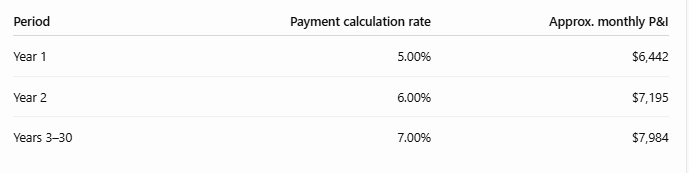
A 2-1 buydown temporarily reduces the borrower's mortgage payment during the first two years of the loan.
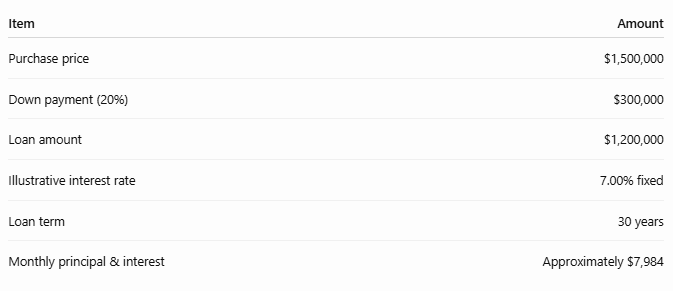
For illustration, assume the mortgage has a 7% note rate:
Year 1 → Payment calculated as if the rate were 5%
Year 2 → Payment calculated as if the rate were 6%
Year 3+ → Payment based on the full 7% note rate
Importantly, the actual note rate in this example remains 7%.
The difference between the reduced payments and the payment based on the note rate is funded upfront through the temporary buydown account, subject to the applicable loan program and lender requirements.
That distinction matters. A 2-1 buydown isn't a 5% mortgage. It's a strategy for temporarily reducing the initial payment.
Why Consider It?
For some buyers, the first few years after purchasing a home can be particularly important financially.
There may be moving expenses, renovations, furniture purchases or simply the adjustment to a new monthly housing expense.
A temporary buydown can potentially provide additional cash-flow flexibility during that period.
But that doesn't automatically make it the right strategy.
The Better Question Is: Where Should the Money Go?
Suppose you're negotiating a purchase and the seller is willing to provide a concession.
There may be several ways those dollars could potentially be used, depending on the loan program and transaction:
- Reduce eligible closing costs
- Fund a temporary 2-1 buydown
- Pay discount points for a permanent rate reduction
- Negotiate the economics of the purchase differently
This is where buyers should move beyond simply asking:
“How much can I get the seller to contribute?”
The more useful question is:
“Where will those dollars create the greatest financial benefit for me?”
$20,000 Off the Price—or $20,000 Toward Financing?
Consider a simplified example.
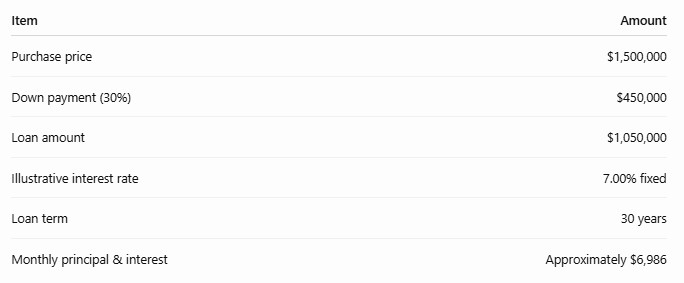
Suppose a buyer is purchasing a $1.5 million home with 20% down, resulting in a $1.2 million loan.
If the seller is willing to negotiate approximately $20,000 of value, reducing the purchase price by $20,000 sounds significant.
The new price becomes $1.48 million, and at the same 80% financing structure, the loan would decrease by approximately $16,000.
At a hypothetical 7% rate on a 30-year loan, that $16,000 reduction in principal would lower principal and interest by only about $106 per month.
That's useful—but it illustrates why purchase price shouldn't be the only number evaluated.
If an eligible seller contribution can instead be applied toward financing costs or a temporary buydown, the near-term cash-flow effect could be materially different.
That doesn't mean the seller credit is automatically better.
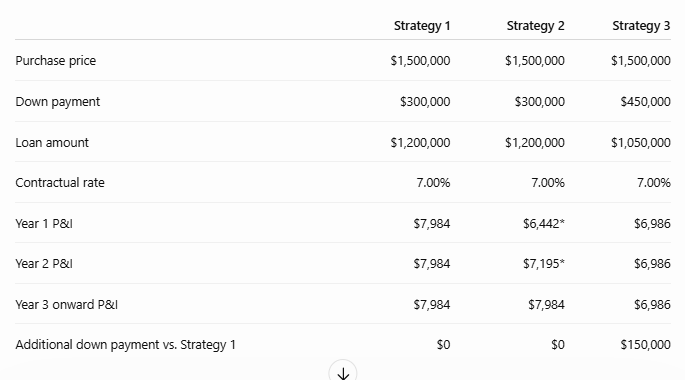
It means you should run both scenarios before deciding what to negotiate.
Temporary vs. Permanent Buydown
This is another important distinction.
With a temporary 2-1 buydown, the note rate itself does not change. Funds are set aside upfront to subsidize a portion of the payment during the first two years.
With a permanent buydown, discount points are generally paid at closing in exchange for a lower note rate for the life of the loan.
Which strategy makes more sense depends on several factors, including:
How long you expect to own the property.
A permanent buydown may require enough time for the monthly savings to recover the upfront cost.
Your near-term cash-flow priorities.
A temporary buydown may provide greater payment relief during the first two years.
The cost of each option.
The numbers need to be compared—not assumed.
Your broader financial strategy.
Keeping additional capital invested or available may be more important to one buyer than minimizing the mortgage payment is to another.
There isn't a universal answer.
What About Refinancing Later?
This is where I believe buyers need to be particularly careful.
A 2-1 buydown is sometimes presented with the assumption:
“Take the lower payment now, and refinance when rates fall.”
I wouldn't build a financial strategy around that assumption.
No one can guarantee where mortgage rates will be one or two years from now. And even if rates decline, refinancing will depend on the borrower's financial circumstances, property value, lending guidelines and market conditions at that time.
The mortgage should make sense even if refinancing never happens.
If rates eventually create an attractive refinancing opportunity, that's a potential additional benefit—not something the original purchase should depend upon.
Chris's Market Perspective
One of the advantages buyers have in today's market is the ability to think beyond the headline rate.
When I'm evaluating a transaction, I'm not looking only at:
“What's the mortgage rate?”
I'm also looking at:
What can we negotiate? How should the loan be structured? And where will each dollar create the greatest benefit?
My perspective as both a Mortgage Advisor and Compass Real Estate Advisor allows me to evaluate those decisions together rather than treating the property negotiation and financing as two completely separate conversations.
Sometimes the better strategy is price.
Sometimes it's a seller contribution.
Sometimes it's a temporary or permanent buydown.
And sometimes the right decision is to keep the financing simple.
The objective isn't to use every available strategy. It's to use the right one.
The Bottom Line
Today's mortgage market requires more than simply shopping for a rate.
A well-structured transaction can involve the purchase price, seller concessions, closing costs, down payment, loan structure and monthly payment working together.
A 2-1 buydown is one tool within that larger strategy.
Used appropriately, it can create valuable short-term payment flexibility.
Used simply because rates are high, without comparing the alternatives, it may not be the best use of your negotiating dollars.
Considering a Property?
Send me the purchase price and estimated down payment.
I'll compare how the numbers could look with and without a 2-1 buydown, so you can evaluate the strategy before making a decision.
This communication is for educational and informational purposes only and is not an offer or commitment to lend. Any rates used above are hypothetical examples for illustration only and are not advertised rates or an offer of credit. A temporary 2-1 buydown does not change the note rate; eligible funds are applied to temporarily reduce the borrower's payment during the buydown period. Availability, permitted funding sources, qualification requirements and contribution limits vary by loan program, lender, borrower and transaction. Buyers must qualify under applicable underwriting and investor guidelines. Rates, programs, terms and conditions are subject to change without notice. Refinancing is not guaranteed and should not be assumed when evaluating a temporary buydown. Payment examples exclude property taxes, homeowners insurance, HOA dues and other applicable expenses; actual payment obligations may be higher. All loans are subject to underwriting and investor approval; not all applicants will qualify. Chris Pessy, SVP of Mortgage Lending, United American Mortgage Corporation (UAMCO), NMLS #208346. Equal Housing Opportunity.