The Cost Nobody Modeled

The Hidden Affordability Crisis: Why It’s No Longer Just About Mortgage Rates

For much of the past two years, the housing conversation has revolved around a single variable:

mortgage rates.

Would rates come down?
Would monthly payments improve?
Would affordability return once financing became cheaper?

That focus was understandable.

But it is now incomplete.

Because a growing number of homeowners across the country are facing a very different form of financial pressure—one that has little to do with whether their mortgage rate is fixed or adjustable.

A major national housing report released this week revealed that U.S. foreclosure filings rose nearly 26% year-over-year in the first quarter, reaching the highest level seen in six years.

Surprisingly, this is not being driven by the kind of reckless lending or subprime mortgage products that defined the 2008 housing collapse.

Instead, analysts are pointing to something quieter:

the total cost of owning a home is rising faster than many homeowners anticipated.

And that is creating what can best be described as:

a hidden affordability crisis.

The Monthly Payment Is No Longer Just the Mortgage

For years, many buyers simplified affordability into one straightforward equation:

Purchase Price + Interest Rate = Monthly Payment

That formula no longer tells the full story.

Today, the actual cost of homeownership includes an expanding list of secondary expenses that are moving materially higher, including:

  • property taxes,
  • homeowners insurance,
  • HOA and condo association dues,
  • reserve assessments,
  • maintenance inflation,
  • utility cost increases.

In many cases, homeowners still have fixed mortgage loans they can technically afford.

What is causing distress is everything surrounding the mortgage.

According to the recent ATTOM foreclosure data cited this week, nearly 119,000 U.S. properties recorded a foreclosure filing in Q1 alone, the highest quarterly level since early 2020.

That statistic matters because it confirms an important shift:

the affordability strain is increasingly ownership-cost driven—not simply mortgage-rate driven.

Why This Is Becoming a Serious Issue in California and Florida

As someone who advises buyers in both California and Florida, I am seeing this pattern surface repeatedly in two very different housing environments.

The line items differ.

The end result does not.

Florida: The Ownership Stack Has Quietly Expanded

Florida buyers today are dealing with a materially different monthly ownership burden than they were just a few years ago.

In addition to principal and interest, they are now facing:

  • sharply repriced homeowners insurance,
  • flood and windstorm premium pressure,
  • HOA reserve contribution increases,
  • condo special assessments,
  • deferred maintenance catch-up in older buildings.

Many condominium communities have had no choice but to increase monthly dues as reserve requirements and building repairs accelerate.

This means buyers are often entering a property attracted by the purchase price…

only to discover that the full monthly carry is significantly heavier than originally modeled.

This is one reason Florida has remained among the states with the highest foreclosure activity in the nation over the last year.

California: A Different State, Same Financial Compression

California’s issue is not condo reserve reform.

California’s issue is cumulative ownership burden.

Buyers are contending with:

  • elevated property tax carry on high acquisition values,
  • insurance repricing in wildfire-sensitive areas,
  • higher utility obligations,
  • maintenance and labor inflation.

Even high-income buyers are noticing that the “comfortable payment” they once projected is no longer as comfortable once all real ownership costs settle in.

And because California acquisition prices are already high to begin with, there is less room for secondary costs to rise without creating monthly strain.

The Dangerous Assumption Many Buyers Are Still Making

One of the biggest misconceptions in today’s market is this:

“If I can qualify for the mortgage, I can afford the home.”

That assumption is increasingly flawed.

Mortgage qualification simply means the borrower fits a lender’s debt-to-income parameters at the time of underwriting.

It does not automatically mean:

  • the insurance profile is sustainable,
  • the tax burden is ideal,
  • the HOA is financially healthy,
  • the reserve obligations are manageable,
  • or the maintenance burden is low.

In other words:

lender approval does not equal long-term payment safety.

This distinction is becoming one of the most overlooked financial risks in residential real estate today.

What Sophisticated Buyers Are Doing Differently in 2026

The smartest buyers are no longer asking only:

“What rate can I get?”

They are asking:

“What is the all-in monthly cost of controlling this specific asset?”

That means underwriting far beyond the mortgage note:

Reviewing the property tax trajectory

Evaluating the homeowners insurance environment

Studying HOA budgets and reserve health

Identifying pending assessments or maintenance exposure

Stress-testing the total monthly ownership cost 6–12 months out

Because increasingly:

  • the lower-priced property is not the lower monthly burden,
  • and the lower interest rate quote is not the complete affordability solution.

The property itself now requires as much financial scrutiny as the financing.

Why This Matters More Than Ever Going Forward

This recent foreclosure data is not necessarily signaling a national housing collapse.

But it is signaling something equally important:

a growing disconnect between what buyers think they can comfortably own and what homes are actually costing them to carry over time.

That disconnect creates:

  • homeowner stress,
  • future listing pressure,
  • payment delinquencies,
  • and poor acquisition decisions.

For buyers entering the market now, this means the winning strategy is no longer simply:

find the best rate and negotiate the best price.

The winning strategy is:

fully underwrite the ownership ecosystem attached to the property before committing.

Final Thought

The housing market’s affordability problem has evolved.

It is no longer just about whether mortgage rates are high.

It is about whether the total financial instrument called “homeownership” still fits comfortably once taxes, insurance, HOA obligations, and long-term carrying costs are layered in.

That is where the hidden payment shock is occurring.

And that is where smarter buyers can still protect themselves—if they analyze both the financing and the asset together.

Need a Full Ownership-Cost Review Before Buying?

If you are considering a purchase in California or Florida and want a true all-in monthly affordability analysis before writing an offer, feel free to connect directly.

A mortgage pre-approval is only one part of the equation.

The property itself needs to make financial sense too.

Florida Real Estate Market 2026: Why Strategic Buyers Are Moving Again

The Florida Buyer Window Just Changed: Why Strategic Buyers Are Beginning to Move Again

Florida’s market is no longer being defined by hesitation — it is being shaped by negotiation.

For the past two years, many buyers chose to remain on pause, waiting for lower mortgage rates, more certainty, and stronger opportunities before making a move.
That hesitation was understandable.

Financing costs rose, inventory felt inconsistent, and many prospective purchasers preferred patience over urgency.

But this week’s housing and mortgage data point to something important:

that period of anticipation is now beginning to evolve.

Not because rates have suddenly dropped in any dramatic way…

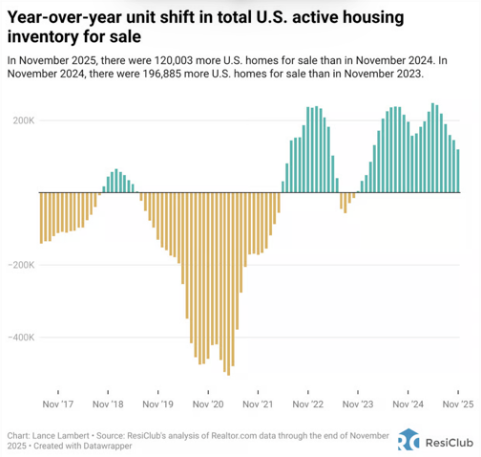
but because expanding inventory, increased seller flexibility, and more strategic financing options are beginning to create a more favorable buying environment across Florida.

In other words:

this is not necessarily becoming a cheaper market.

It is becoming a more negotiable one.

Here are three key signals worth watching.

Buyer Negotiation Power Is Quietly Returning

One of the clearest shifts in today’s Florida market is not just what rates are doing — it is how transactions are beginning to behave.

As inventory normalizes and homes spend longer on the market, flexibility is gradually returning to the negotiating table.

Buyers are once again seeing opportunities for:

  • seller-paid closing costs,
  • mortgage rate buydown contributions,
  • inspection and repair concessions,
  • stronger contractual terms,
  • improved capital preservation.

That matters because affordability today is no longer determined solely by the mortgage rate.

It is increasingly determined by how well the transaction is structured.

A buyer looking only at headline rates may continue waiting.

A buyer looking at the full negotiation stack may discover meaningful financial advantage available now.

Rates Remain Elevated — Yet Serious Buyers Are Re-Engaging

Mortgage rates moved modestly higher again this week.

Historically, that would have been enough to keep many purchasers frozen.

This time, buyer behavior is showing something different:

serious buyers are beginning to move despite imperfect rates.

Why?

Because disciplined purchasers are starting to focus less on rate perfection and more on total positioning:

  • securing the right asset,
  • negotiating from improved leverage,
  • preserving the option to refinance later,
  • entering before buyer competition fully returns.

This is a more strategic way to buy.

And in many cases, it can produce a better long-term outcome than simply waiting for the lowest possible interest rate.

South Florida Continues to Attract Disciplined Capital

South Florida remains one of the nation’s most resilient destinations for long-term wealth.

Even with broader economic uncertainty, the region continues attracting:

  • domestic relocators,
  • foreign national purchasers,
  • second-home buyers,
  • wealth preservation investors.

These buyers are not making decisions based solely on short-term mortgage movement.

They are looking at:

  • tax efficiency,
  • geographic diversification,
  • U.S. dollar asset ownership,
  • lifestyle migration,
  • long-duration capital preservation.

This is not speculative demand.

It is disciplined capital — and disciplined capital tends to move while terms are quietly improving.

Why This Matters More Than Buyers Realize

Viewed separately, these developments may seem incremental.

Viewed together, they paint a much clearer picture.

Florida is beginning to show several conditions that often precede strategic acquisition windows:

  • more available inventory,
  • softer seller rigidity,
  • financing still accessible,
  • serious demand quietly re-entering.

These are rarely the moments that feel euphoric.

But they are often the moments that create the best total buying structure before broader competition returns.

That is why waiting exclusively for “perfect” conditions may no longer be the strongest strategy.

The Better Question Buyers Should Be Asking

For two years, the dominant question has been:

Should I wait?

The more important question now may be:

What can be gained by structuring correctly today?

That means evaluating:

  • seller concession opportunities,
  • temporary or permanent rate buydowns,
  • intelligent loan product selection,
  • liquidity preservation,
  • refinance horizon planning,
  • neighborhood-specific inventory shifts.

This is where a purchase becomes more than a home search.

It becomes a coordinated real estate and mortgage strategy.

A More Strategic Buyer Climate Is Emerging

The best buying windows are not always marked by dramatically lower rates.

Often, they emerge when:

  • financing remains workable,
  • sellers begin to soften,
  • inventory becomes available,
  • and the majority of buyers are still psychologically waiting.

Florida is beginning to show several of those characteristics.

For prepared buyers and investors, this is less about chasing urgency —

and more about recognizing intelligent timing.

If you are evaluating a Florida home purchase, second residence, relocation, or strategic investment, understanding how to align financing, negotiation, and timing may be more important now than simply waiting for rates alone.

The Freeze Is Breaking

The Housing Market Is No Longer Standing Still: Why Opportunity Is Quietly Returning

For much of the last two years, residential real estate has been defined by one word:

hesitation.

Buyers waited for rates to improve.
Sellers held onto low existing mortgages.
Financing decisions became increasingly deliberate.

The result was a market that felt stalled.

That is beginning to change.

Not with dramatic headlines—but with enough measurable movement in rates, inventory, and seller behavior to create a more strategic environment than we have seen in months.

Across both Florida and California, the data is pointing toward one clear conclusion:

the market is quietly becoming more fluid.

Mortgage Conditions Have Improved Modestly

Mortgage rates remain above historic pandemic lows, but they have eased enough from prior highs to restart buyer conversations.

This matters because purchasing decisions are no longer being based solely on “waiting for the perfect rate.”

Many qualified buyers are now looking at the bigger picture:

  • improving inventory,
  • more balanced negotiations,
  • long-term property value,
  • and timing before broader demand returns.

Today’s opportunity is less about chasing a headline rate and more about recognizing when overall acquisition conditions begin to improve.

Sellers Are Finally Beginning to Move

One of the biggest restraints on housing over the last two years has been the mortgage lock-in effect.

Millions of owners secured ultra-low mortgage rates and simply refused to sell.

That resistance is now starting to soften.

More homeowners are beginning to make decisions based on:

  • relocation,
  • lifestyle changes,
  • investment adjustments,
  • family needs,

rather than staying frozen by an old mortgage.

The result:

fresh inventory is beginning to return.

And when inventory improves, buyers gain something they have not had much of lately—choice.

Buyers Are Regaining Negotiating Room

As listings slowly build, transaction leverage is beginning to shift.

In both Florida and selective California markets, buyers are increasingly finding opportunities to:

  • request seller contributions,
  • negotiate inspection items,
  • discuss repair credits,
  • structure stronger financing contingencies,
  • and create better overall contract terms.

This does not mean every market has turned buyer-friendly overnight.

It means the environment is becoming more balanced.

That balance creates room for strategy.

And strategic purchases are often made in these exact transition periods.

Why This Matters in Florida and California

These two states remain among the most active and desirable housing markets in the country, but buyer behavior has changed significantly.

Today’s buyers are:

  • more analytical,
  • more payment conscious,
  • less emotional,
  • and far less likely to overpay without justification.

That means sellers must be more realistic, and buyers who are properly advised can often structure far smarter deals than they could a year ago.

This is where understanding both:

  • the real estate side, and
  • the financing side

becomes critical.

Because price alone no longer tells the full story of whether a deal is truly advantageous.

This Is Not a Boom Market—It Is a Positioning Market

We are not looking at another frenzy.

We are looking at a quieter but more tactical opportunity window created by:

  • moderating mortgage pressure,
  • improving listing availability,
  • softer seller resistance,
  • and more flexible negotiations.

These are incremental advantages.

But incremental advantages are often where long-term wealth decisions are made.

By the time the headlines become obvious, much of the positioning opportunity is usually gone.

Work With an Advisor Who Understands Both Sides

As both a Global Mortgage Advisor and Certified Global Realtor, I help clients evaluate:

  • property opportunity,
  • financing implications,
  • and market timing.

If you are considering a purchase, sale, refinance review, or international real estate move, feel free to reach out for a confidential consultation.

Buying Real Estate in 2026: What Most Miss

The Market Just Shifted—But Not the Way Most Think

A Strategic Window Is Opening for Buyers Who Understand How to Play It

For the past few years, the real estate conversation has been dominated by one question:

“Where are rates going?”

But this week’s data—and what’s happening beneath the surface—points to a more important shift:

The market is no longer about timing. It’s about strategy.

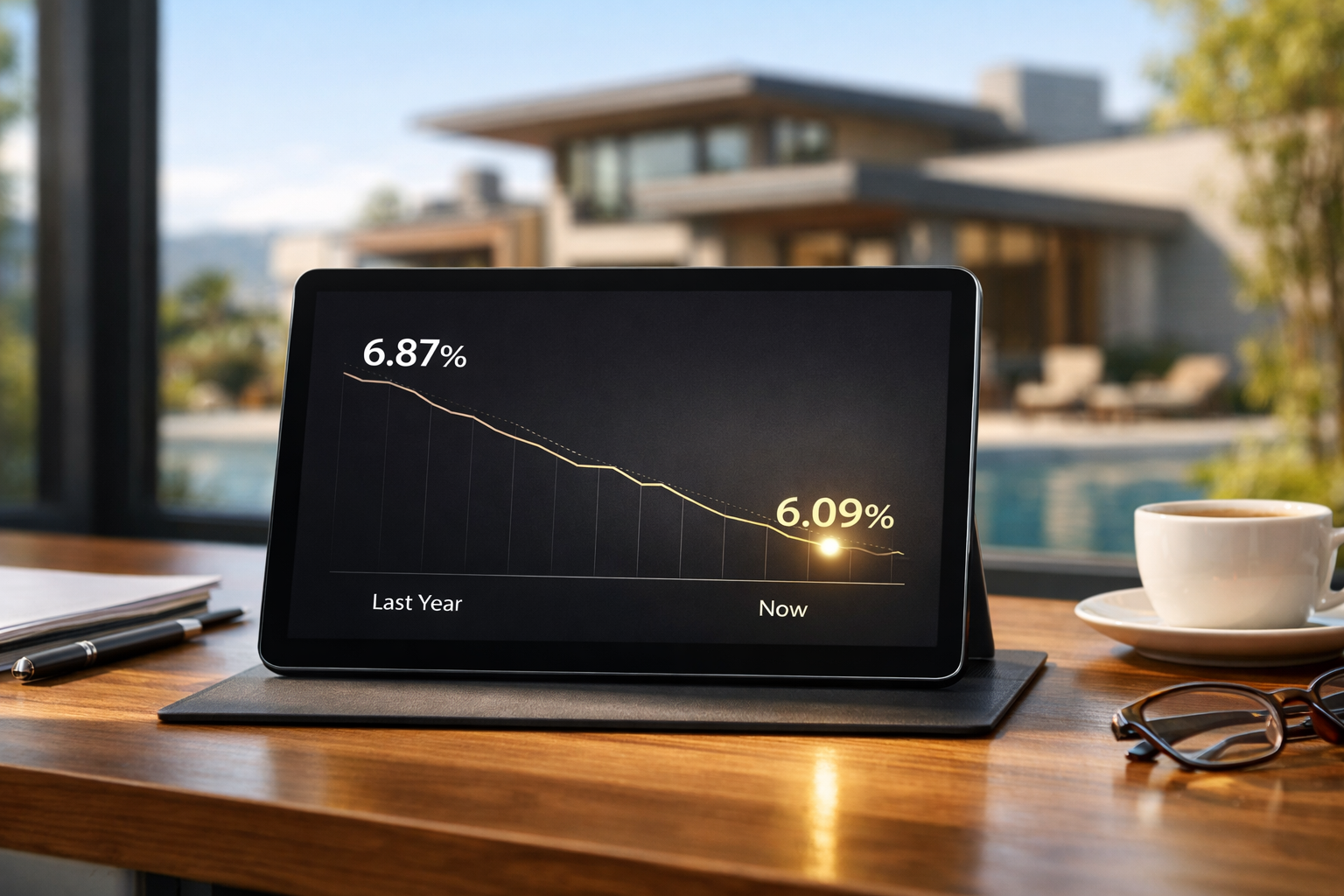
Mortgage rates have eased again, hovering in the low 6% range, offering some relief compared to recent highs. But focusing solely on rates right now is missing the bigger picture.

Because while rates fluctuate…

Leverage is quietly returning to the buyer.

What’s Actually Changing in the Market

We are transitioning out of a reactive, rate-driven environment and into what can best be described as a:

Precision Market

This type of market rewards preparation, structure, and informed decision-making over speed or speculation.

Here’s what we’re seeing right now:

  • Inventory is increasing, particularly across Florida markets
  • Days on market are extending, giving buyers more time to evaluate
  • Sellers are becoming negotiable again, especially on terms
  • Demand remains steady, but more selective and strategic

Meanwhile, in California:

  • Inventory remains tighter
  • Prices continue to show resilience
  • Transaction volume is slower—but not stagnant

Translation:
This is no longer one national market.

It’s a fragmented, opportunity-driven landscape where outcomes vary dramatically based on location, timing, and—most importantly—how the deal is structured.

The Biggest Mistake Buyers Are Still Making

Many buyers are still sitting on the sidelines, waiting for the “perfect rate.”

It’s understandable—but it’s also costly.

By the time rates feel perfect, the opportunity usually isn’t.

Why?

Because when rates drop meaningfully:

  • Competition increases
  • Negotiation power disappears
  • Prices often move upward
  • Seller concessions shrink

What we are seeing right now is a temporary imbalance:

Rates are still relatively elevated
But buyer leverage has improved

That combination is where opportunity lives.

Why Financing Strategy Matters More Than Ever

This is where most buyers—and even many agents—get it wrong.

They treat financing as a step in the process, not a tool for advantage.

In today’s market, financing is the strategy.

The difference between a good deal and a great one often comes down to how the transaction is structured.

Key strategies being used right now:

1. Temporary Rate Buydowns (2-1 / 3-2-1)

  • Lower initial payments
  • Improve short-term cash flow
  • Create flexibility while waiting for future refinance opportunities

2. Seller Concessions

  • Cover closing costs
  • Fund interest rate reductions
  • Offset upfront capital requirements

3. Asset-Based & Alternative Income Structuring

  • Ideal for high-net-worth and international buyers
  • Leverages liquidity instead of traditional income

4. Pre-Positioned Refinance Strategy

  • Enter the market now
  • Optimize the debt later when rates improve

In many cases, two buyers can purchase the same property—and have completely different financial outcomes—based solely on structure.

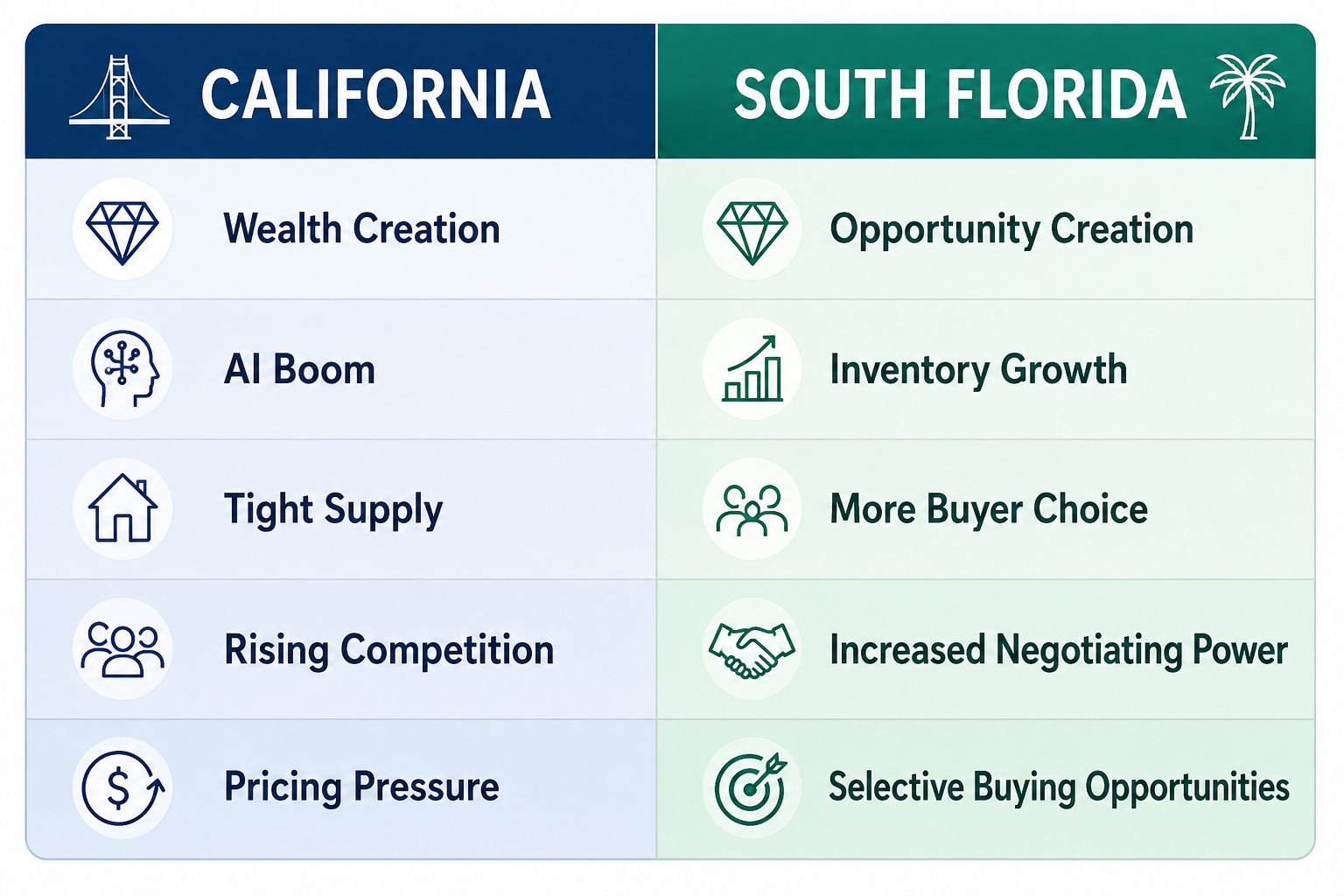
A Market Split: Florida vs. California

For buyers operating across multiple markets—or considering second homes—this is where things get particularly interesting.

Florida:

  • Increasing inventory
  • More negotiable sellers
  • Growing buyer leverage
  • Strong appeal for international and lifestyle buyers

California:

  • Continued supply constraints
  • Price resilience in key areas
  • Selective opportunities for well-positioned buyers

This divergence creates a unique opportunity:

Capital can be deployed more strategically than at any point in the last three years.

The International Buyer Advantage

For international clients and globally mobile buyers, this environment is especially favorable.

Why?

Because:

  • Less competition at the moment
  • More flexibility in structuring financing
  • Greater negotiating power
  • Currency and diversification considerations

Combined with the right advisory approach, this creates a window to enter premium U.S. markets with more control and less pressure.

Chris’s Final Thought

Control the asset. Structure the debt.

If you are considering a purchase in the next 6 to 12 months, the opportunity is not in waiting for the perfect rate.

It’s in preparing the right strategy now.

Because when the right property appears, success is determined by your ability to act with precision—not hesitation.

Ready to Position Yourself Strategically?

Whether you’re looking in Florida, California, or exploring cross-border opportunities, the key is having a plan that aligns:

  • Your capital
  • Your financing strategy
  • Your long-term objectives

→ Explore available luxury buildings and opportunities:
https://www.chrispessymiamirealestate.com/buildings

Or reach out directly to structure a personalized approach based on your goals.

0 results
Clear all
Thank you! Your submission has been received!
Oops! Something went wrong while submitting the form.

Schedule a call below, talk to us directly about your future home, sale, or investment.

/
Chris
Pessy
, 
I’ve always been impressed with Chris’s approach. I've worked with many professionals Internationally in the industry, but Chris truly stands out. His 24/7 unwavering commitment make a stressful day feel like a breeze.
-
Andrea & Veronica Bocelli
,
Chris goes above and beyond for our clients! His dedication to excellence and unwavering commitment to excellence set him apart in the industry. Our shared passions for people and delivering results for clients make collaborating with him fun and successful" —
-
Josh Altman / Million Dollar Listing
,
"As a seasoned real estate investor, I was thoroughly impressed by Chris's unparalleled professionalism and market expertise. Chris navigated the complexities of the transaction process with ease, always providing insightful guidance and an exceptional level of availability.”
-
Miguel Forbes / Forbes Family Trust.
,
“From the moment I engaged with Chris, I knew I was in good hands. His professionalism and ability to “line up all the stars” months in advance of making my offer resulted in my first off-market dream home purchase becoming a reality." —
-
Rob Garza / Founder Thievery Corporation
,
Coming from the world of hospitality, working with Chris has been a pleasure! His big heart, extensive network and deep understanding of the luxury real estate landscape gave the Mina Family access to the right opportunities and people to get the job done”
-
Michael Mina / Founder The Mina Group
,
"Chris is more than just a Real Estate Veteran and Influencer – he's a trusted advisor and friend. His genuine care for his clients and passion for his work shine through in everything he does.”
-
Juan Sanchez / Co-Founder Clase Azul Tequila
,

My mission is to provide an unparalleled level of service and build genuine connections, ensuring every client's real estate journey is seamless, transparent, and rooted in trust.

© 2015
The Chad Carroll Group | Compass Florida's #1 Team
. All Rights Reserved. Sitemap, Privacy Policy and Terms of Use
DRE #
3596049